
"Find Your Passion" Is Terrible Advice
"Janis, I think I've lost my passion and drive."
My client said those words to me last month, and I watched her face just... crumple. Not just disappointment—shame. Like she'd failed at the most basic requirement of being a functioning professional human: being passionate about her work.
And here's the thing—she's brilliant. Like, truly brilliant. She's built something real and helped so many people. But because she woke up tired one too many mornings, because the work felt hard instead of magical, because she couldn't muster that perfectly curated Instagram enthusiasm we're all supposed to radiate 24/7—she thought something was fundamentally broken in her.
Sitting there with her, I realized: we've been asking ourselves the completely wrong question.
We've Been Lied To About Passion
Look, I'm not here to trash the idea of loving your work. That's not what this is about.
But can we just be honest for a second? The whole "find your passion" industrial complex has done us dirty.
We've been told:
You should feel constantly energized by your work (spoiler: you won't)
Your purpose should be crystal clear and never change (it will)
If you're not "passionate," you're in the wrong place (you're probably not)
Success comes from this burning internal fire, not from actually helping people (backwards)
I've been doing this work for fifteen years now. I've worked with hundreds of experts, entrepreneurs, creatives, coaches—people who are legitimately good at what they do. And I can tell you: passion is a terrible North Star.
Here's why passion doesn't work:
It's fickle as hell. Your passion level changes with your sleep, your hormones, your last difficult client call, whether you remembered to eat lunch. One day you're ready to conquer the world. The next day you're googling "how to become a park ranger" at 2am.
It's performative. We've turned passion into another thing we have to perform on LinkedIn. You're supposed to post about how you "can't believe you get paid to do this!" and how much you love Monday mornings and how #blessed and #grateful you are. It's exhausting. And honestly? It's not even real half the time.
It's privileged. "Follow your passion" assumes you have the luxury of picking work based purely on vibes rather than, you know, actual necessities like rent and groceries and health insurance.
It's lonely. When passion is your metric, everything becomes about you—your feelings, your fulfillment, your fire. And when that fire inevitably flickers (because you're human), you're left alone wondering what's wrong with you.
I've watched incredibly talented people blow up entire careers not because the work wasn't good or needed—but because they confused totally normal energy fluctuations with being fundamentally misaligned.
What If We Asked a Different Question?
So here's what I asked my client. And here's what I'm asking you:
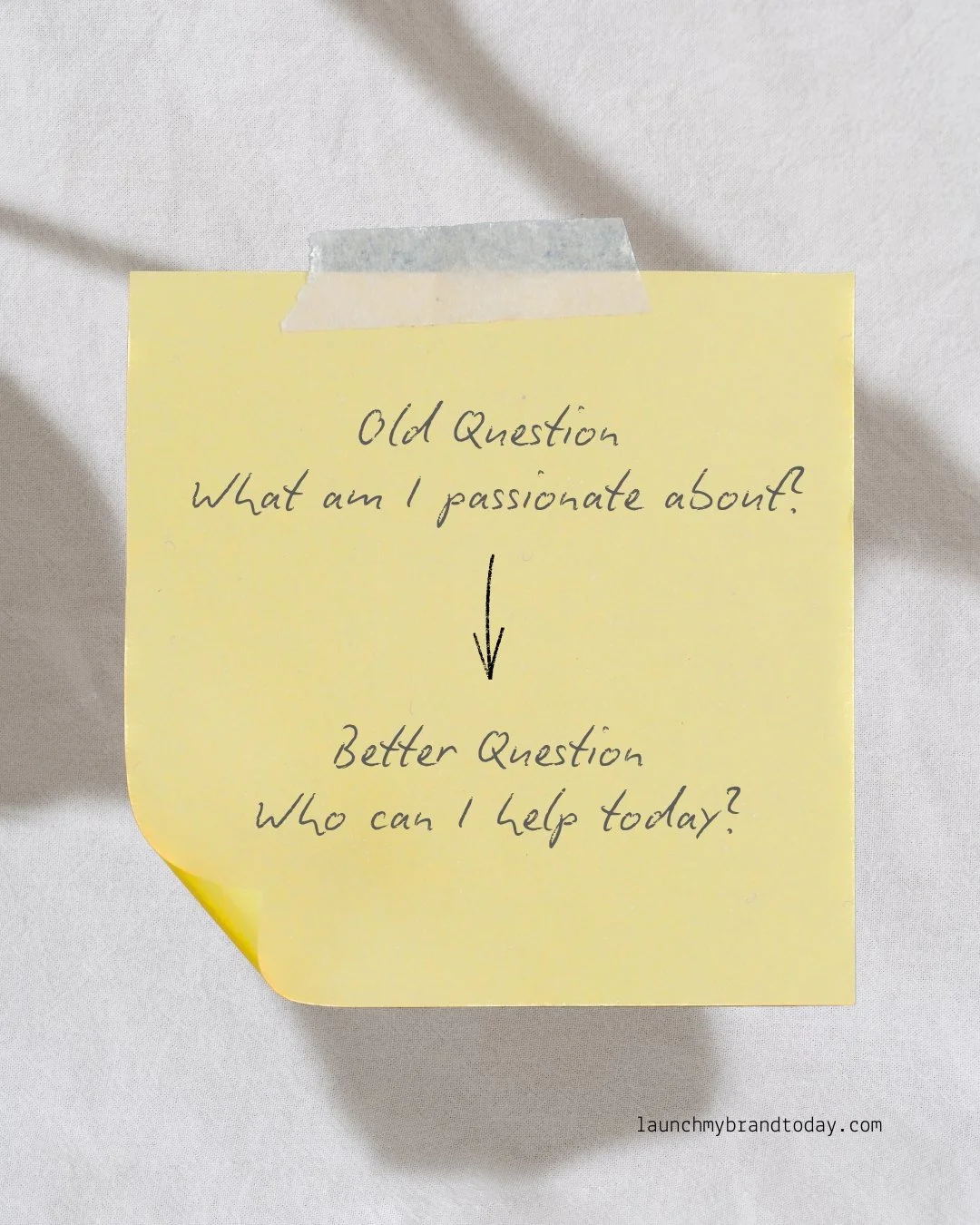
What if instead of "What am I passionate about?" we asked "Who can I help today?"
What if we stopped chasing passion and started practicing usefulness instead?
Stay with me. I know "usefulness" doesn't sound sexy. It doesn't have the same ring as "follow your passion" or "find your purpose."
But it's so much more powerful. And sustainable. And real.
Here's What Happens When You Shift to Usefulness
You get present.
Instead of constantly digging around inside yourself trying to locate some feeling that may or may not be there, you look outward. Who's in front of me? What do they actually need? How can I be useful right now?
It's simpler. It's clearer. It's something you can actually do.
You build momentum.
Passion sits around waiting for inspiration to strike. Usefulness creates its own energy.
Every time you help someone, you get feedback. You see impact. You build confidence. That forward motion generates its own heat—not the frantic, unsustainable burn of passion, but something steadier. Something you can count on.
You get flexibility.
Your usefulness can evolve. The people you help can change. The problems you solve can shift.
You're not locked into defending some "passion" you discovered at 23 and now feel obligated to perform for the rest of your life.
You create actual connection.
When your work is about usefulness, you're automatically in relationship. You're not alone in your head waiting for the muse to show up. You're in real conversation with real people who have real needs.
This is the part that matters.
What Actually Happened
So back to my client. When she stopped asking "Where's my passion?" and started asking "Who needs what I know?"—everything shifted.
She started saying yes to smaller things. Coffee chats. Quick calls. Five-minute DMs answering someone's question. She showed up to be helpful without needing to feel inspired first.
And guess what happened? The passion came back.
Not as this thing she had to manufacture before she could start. But as this natural byproduct of being consistently useful to people.
Your Brand Isn't Built on Passion (Sorry)
I know, I know. I'm literally the personal brand person. Shouldn't I be telling you to build your brand around your passion?
Nope.
The most powerful personal brands aren't built on passion. They're built on usefulness.
Think about it. The experts you actually follow and trust—are you drawn to them because they seem really passionate? Or because they consistently help you solve problems, think differently, move forward?
When I work with clients on their brands, I don't ask them to excavate their passion. I ask them to excavate their usefulness:
What problems do people actually come to you with?
What questions do people always ask you?
What's the thing people thank you for that seems completely obvious to you?
What do you know that could help someone take their next step today?
This is the archaeology of expertise. You already have this stuff. You don't need to manufacture passion around it. You just need to see where you're already useful and make that visible to more people.
Your personal brand insurance—my whole thing about why everyone needs to own their brand—isn't insurance for your passion. It's insurance for your usefulness.
Your job title can disappear tomorrow. Your company can restructure. Your industry can shift. But if people know what you're useful for? If they understand the specific value you bring? That's transferable. That's sustainable. That's real equity.
How to Actually Make This Shift
Okay, so how do we do this? How do we stop performing passion and start being useful?
1. Make a usefulness inventory
For the next week, just notice every time someone asks you for help, advice, a recommendation, your perspective on something. Don't filter it. Don't dismiss the "small" stuff.
Just track:
What did they ask?
What did you offer?
What happened?
You're looking for patterns. Where does your expertise naturally intersect with other people's needs?
2. Ask better questions
Stop asking yourself: "Am I passionate about this?"
Start asking: "Is this useful?"
Stop asking: "Does this excite me?"
Start asking: "Does this help someone move forward?"
Stop asking: "Is this my calling?"
Start asking: "Is this where I can make a difference today?"
3. Practice micro-usefulness
You don't need to change the world today. You need to help one person. Answer one question. Solve one problem. Share one insight.
Right now, think of five people in your network. Next to each name, write: "What do I know that could help them right now?"
Then actually reach out. Make an introduction. Share an article. Offer fifteen minutes of your time.
See what happens when you show up to be useful without needing to feel passionate first.
4. Reframe your "off" days
When you wake up unmotivated, don't spiral into "Oh god, I've lost my passion, everything is terrible, I should quit."
Just ask: "Who can I help today despite how I feel?"
Some of my absolute best work has happened on days when I felt completely uninspired. But I showed up anyway. Not for the feeling—for the usefulness. And weirdly, the feeling usually followed.
5. Build your brand on usefulness, not passion
When you talk about your work—on LinkedIn, in conversations, on your website—lead with the problem you solve, not the feeling you have about it.
Don't say: "I'm so passionate about marketing!" (Honestly, who cares?)
Say: "I help invisible experts become visible so they can reach the people who need them." (Now we're talking.)
Don't say: "I love what I do!" (Cool story.)
Say: "I solve this specific problem for these specific people." (Now I know when to come to you.)
Your usefulness is your value proposition. Make it clear. Make it tangible. Make it stupidly easy for people to know when they need you.
Passion is a feeling. Usefulness is a practice.
Feelings are great. I'm not anti-feeling. But they're terrible guides for building a career, a business, a life you can actually sustain.
Usefulness is something you can do regardless of how you feel. You can measure it. You can improve it. It creates its own momentum.
And here's the beautiful paradox: when you stop chasing passion and start practicing usefulness, passion usually shows back up. Not as this prerequisite you have to manufacture—but as a reward. As this natural thing that happens when you're making a real difference.
Because there's nothing more energizing than knowing you actually helped someone. Nothing more motivating than watching someone move forward because you showed up. Nothing more sustaining than being in real relationship with the people your work serves.
You haven't lost your passion. You've just been asking it to do too much. Passion was never supposed to be the foundation. It was supposed to be the joy you feel when you're being deeply, consistently useful.
So What Now?
Tomorrow morning, don't ask yourself if you're passionate about your work.
Ask yourself: Who can I help today? Who needs what I know? Who can I be useful to?
And then just do that. Show up. Be useful. See what happens.
The world needs more people willing to be useful with what they already have.
You already have everything you need. You already know things worth sharing. You already have value to offer.
The question isn't whether you're passionate enough.
The question is: Who needs you to show up today?